
The Autopsy
Chegg Inc. (NYSE: CHGG) is a body on the table. A completed event, not a live thesis.
Peak market cap: $14 billion, February 2021. Ed-tech darling. The company that was supposed to own the homework economy. Current market cap: roughly $70 million. Stock price: $0.63.
That’s a 99.5% decline.
The cause of death wasn’t complicated. ChatGPT launched in November 2022. Six months later, Chegg CEO Dan Rosensweig mentioned it on a May 2023 earnings call. The stock dropped 49% in a single session.
What followed was a slow-motion collapse that management couldn’t outrun. Subscribers fell from 4.4 million at peak to 3.8 million by Q3 2024 (down 13% year-over-year), then to 3.2 million by Q1 2025 (down 31%), then to 2.6 million by Q2 2025 (down 40%). By the Q4 2025 earnings call on February 9, 2026, the company stopped reporting exact subscriber numbers entirely, describing only “more than one million students” on the legacy Chegg Study platform. When you stop counting, you’re past the point of managing the decline.
A fall 2024 student survey attributed to investment bank Needham (reported by Gizmodo, November 2024) found that 62% of college students planned to use ChatGPT for the semester, up from 43% in the spring. Only 30% intended to use Chegg, down from 38%. The students voted with their wallets. Or rather, they stopped voting at all: non-subscriber web traffic to Chegg plummeted 49% in January 2025. Chegg attributed the ongoing traffic pressure to changes in search interfaces that served AI-generated answers above its SEO-optimized pages.
Chegg’s response followed the familiar playbook. An AI product (CheggMate, built with OpenAI). Four rounds of layoffs totaling roughly 1,396 employees across 2024 and 2025, with the largest cut, 45% of the remaining workforce (388 people), in October 2025. A strategic review conducted with Goldman Sachs, which concluded in October 2025 with no buyer at an acceptable price. The company decided to remain standalone. Forbes noted dryly that Goldman “did not yield an offer to acquire the company.”
Q4 2025 revenue came in at $72.7 million. Full-year 2025: $376.9 million, with a net loss of $103.4 million. Q1 2026 guidance: $60 to $62 million. For context, Q3 2024 revenue was $136.6 million. The company cut its revenue by more than half in roughly eighteen months.
Any paid middleman whose core deliverable becomes a free button is vulnerable to this same sequence. Ed-tech was just the first sector to find out.
Study the mechanism, because it’s about to fire again.
The Pattern
Pull the timeline apart and a four-step disruption sequence emerges from Chegg’s data, observed rather than theorized.
Step 1: A free AI alternative reaches “good enough” quality for the core use case. Observable KPI: competitor product availability. ChatGPT could solve homework problems. Not perfectly, but well enough that the marginal student stopped paying $14.95 a month. OpenAI launched Study Mode in July 2024, free to all users. Google offered Gemini AI Pro to students at no charge. Microsoft partnered with Khan Academy to make Khanmigo free for teachers.
Step 2: Top-of-funnel traffic collapses first. Observable KPI: non-subscriber web traffic, new signups. Non-subscriber web traffic to Chegg fell 49% in January 2025. These were the casual visitors, the future subscribers, the people one Google search away from signing up. As search interfaces began serving AI-generated answers (per Chegg’s own attribution on earnings calls), the pipeline dried up.
Step 3: Paying subscriber churn follows with a lag. Observable KPI: active subscribers or active buyers, quarter-over-quarter. Subscribers declined 13% year-over-year by Q3 2024, then 21% by Q4 2024, then 31% by Q1 2025, then 40% by Q2 2025. Each quarter worse than the last. By Q4 2025, the company stopped reporting the number.
Step 4: Revenue decline outpaces cost-cutting. Observable KPI: EBITDA margin trajectory post-layoff. Chegg eliminated 45% of its workforce in October 2025. EBITDA guidance still collapsed from $32 to $34 million in Q4 2024 to $10 to $11 million in Q1 2025. The cost cuts can’t keep up because the revenue falls faster than headcount.
The AI Disruption Sequence
Free AI reaches "good enough"
CHGG: ChatGPT Study Mode • FVRR: Midjourney, Copilot • KELYA: AI voice agents
Top-of-funnel traffic collapses
CHGG: -49% web traffic • FVRR: -13.6% active buyers • KELYA: -6.2% organic revenue
Subscriber/client churn accelerates
CHGG: -40% subs by Q2 2025 • FVRR: GMV declining • KELYA: contract renewals softening
Revenue decline outpaces cost-cutting
CHGG: EBITDA collapsed despite 45% layoff • FVRR: 30% layoff, still shrinking • KELYA: margin guide 1.5%
The pattern will repeat. The open question is which companies are currently at Step 1 or Step 2.
”We’re Not Chegg”
The counterargument writes itself. “Chegg was an answer engine. Weak product. Weak moat. My company is different.”
Why that argument fails: the mechanism has nothing to do with homework specifically. It applies to any service where the core value proposition is “a human does a task that AI can now do comparably, for free or near-free.”
In the freelance design market, Midjourney, DALL-E, and Adobe Firefly can produce serviceable logo drafts, social media graphics, and marketing images. Not portfolio-quality work. But good enough for the small business that was paying a freelancer on Fiverr for a quick social post graphic. Same “good enough” threshold that killed Chegg.
In the staffing and admin market, AI voice agents from companies like Retell, Vapi, and Synthflow can handle customer service calls. LLM-based tools handle data entry, scheduling, basic document processing. The threshold is lower than most enterprise buyers realize.
The “just pivot to AI” defense follows the same pattern. Chegg tried it with CheggMate. Fiverr is trying it with Fiverr Go. Kelly Services is trying it with an internal AI assistant called GRACE. The pattern so far: the pivot doesn’t arrest the decline when the competitor’s product is free, or embedded in tools the customer already owns.
One instructive counterexample: Upwork’s AI-related gross services volume grew 53% year-over-year because Upwork positioned itself as a marketplace for AI-skilled workers, not as a direct service provider. Upwork survived, so far, because its value proposition complements AI rather than competes with it. Fiverr and Kelly are on the other side of that line.
I screened roughly a dozen knowledge-work middlemen for four criteria: (a) core business model is human-does-task-for-fee, (b) a clear, free or near-free AI substitute already exists, (c) at least one core KPI (active buyers, organic revenue, headcount) is already declining, and (d) small or mid-cap, where narrative repricing happens fast and options are cheap. Five companies made the initial cut. TaskUs was eliminated because its board approved a take-private in late 2025. Upwork was eliminated because its AI-skilled-worker pivot is working (53% GSV growth). Chegg was already dead and useful only as a precedent. That left Fiverr and Kelly, two different disruption vectors of the same thesis.
Fish #1: Fiverr International
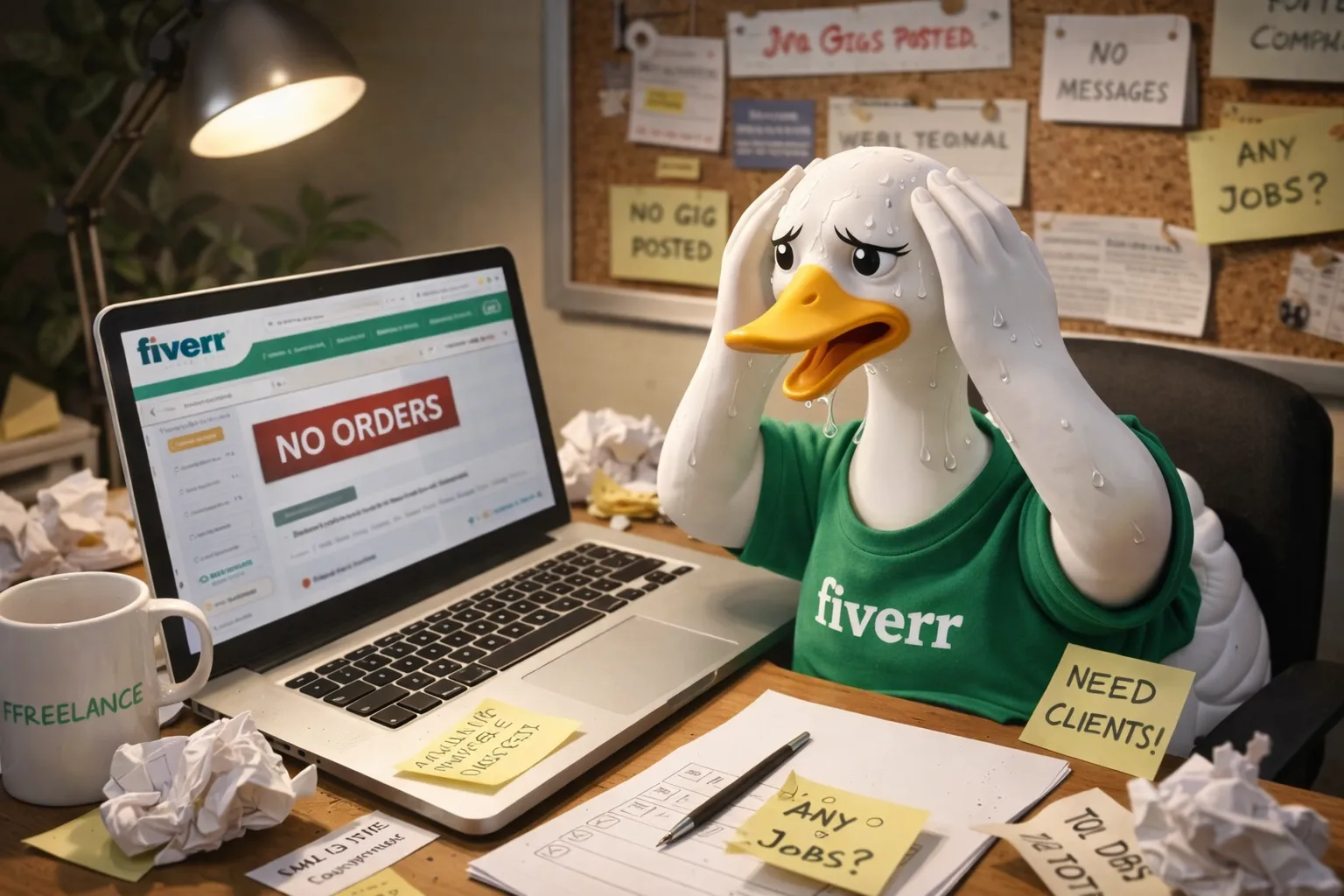
Fiverr International Ltd. (NYSE: FVRR) operates a global online marketplace connecting freelancers with buyers for digital services: graphic design, copywriting, programming, video editing, marketing. Incorporated in Israel, publicly traded in the U.S. Current stock price: $10.65, hovering just above its all-time low of $10.25 hit on February 18, 2026. Market cap: approximately $393 million.
The bleeding has already started, and management said so explicitly.
On September 15, 2025, Fiverr laid off 250 employees, approximately 30% of its workforce. CEO Micha Kaufman announced it as a “painful reset” to become an “AI-first company.” He shared the news in an essay on X.
The stock fell 38% in 2025, then dropped another 17% in a single session on February 18, 2026, after the Q4 earnings report landed with weak 2026 guidance. It’s now down roughly 65% from its 52-week high.
The financial picture from Q4 2025 (reported February 18, 2026): total revenue came in at $107.2 million, up 3.4% year-over-year, but marketplace revenue, the core business, fell 2.7% to $71.5 million. Active buyers dropped to 3.1 million, down 13.6% from 3.6 million a year earlier. The decline is accelerating: it was 6% in 2024, now double digits.
The guidance for Q1 2026 is where it gets ugly: $100 to $108 million in revenue (midpoint $104 million) against analyst estimates of $112.4 million. A 7.5% miss on forward guidance. Full-year 2026 guidance: $380 to $420 million, implying somewhere between a 12% decline and a 3% decline. Analysts had been expecting roughly $450 million.
On the earnings call, management explicitly cited a “significant shift in AI adoption” as the key headwind, not macro weakness, not competition from Upwork. AI adoption, by name, on the record.
The disruption is hitting from two directions simultaneously. On the design side, AI image generators are eating Fiverr’s largest category. A Harvard Business School working paper found a steep decrease in creative freelance gig postings after advanced image generators launched. Fiverr’s own writing and translation category revenue fell 20% year-over-year in 2025 (per the Q4 earnings supplemental). A Ramp Economics Lab analysis from February 2026 found that more than half of businesses spending on freelance platforms in 2022 had completely stopped by 2025.
On the coding side, GitHub Copilot agents launched in May 2025, Google’s Jules entered public beta, and autonomous coding tools like Cursor, Replit Agent, and Claude Code gained traction throughout the year. Programming and web development appear in five of Fiverr’s top-ten service categories. The highest-value gigs on the platform face the fastest-improving AI tools.
Fiverr launched its AI pivot, Fiverr Go, in February 2025. The platform lets freelancers train AI models on their own creative work and sell AI-generated outputs. Over 6,000 sellers activated it, with 200,000-plus buyers engaged by Q1 2025. Management positioned 2026 as “the transformation year.”
But the numbers tell a different story. Active buyers keep declining: 13.6% year-over-year despite the pivot. Total GMV is down 2.2%. The Fiverr Go launch has the same feel as CheggMate: an internal AI product that doesn’t offset the erosion of the core business.
The honest counterpoint: average spend per buyer rose 13% to $342, and projects over $1,000 grew 22.8% year-over-year. The platform is bifurcating. Low-value gigs are leaving for AI tools, while complex, high-value work sticks around. Whether that complex-work tail can sustain the economics of a platform built for volume is the central question.
The Marketplace Plumbing
Fiverr’s marketplace mechanics amplify the disruption rather than cushioning it.
Network effects work in reverse. When freelancers lose gigs to AI, the best ones leave the platform for direct client relationships or full-time positions. Buyer experience degrades as talent thins. Buyer churn accelerates. The flywheel that built the marketplace spins backward when supply quality drops.
**When sellers leave, the marketplace gets worse for buyers. When buyers leave, it gets worse for sellers.** AI is pulling from both sides simultaneously. The network effect that built the marketplace works in reverse when the platform loses its best supply.
Fiverr’s blended take rate sits at 27.7% (twelve months ended December 2025). Sellers pay a flat 20% commission; buyers pay a 5.5% service fee plus a small order fee. Revenue growth through fee increases hits a wall when transaction volume is declining. Higher take rates on fewer transactions is a losing formula.
SMB buyer psychology compounds the problem. Small businesses don’t gradually reduce Fiverr spend. They discover “I can do this myself now” and stop logging in. The churn is binary, not linear. Same pattern as Chegg, where casual visitors collapsed first and subscribers followed with a lag.
And unlike Chegg, where the competitor was a single standalone chatbot, Fiverr faces AI embedded in the tools its buyers already own. Adobe Firefly is inside Photoshop. Microsoft Designer is inside Office 365. Canva’s Magic Studio is built into the free tier. The buyer’s existing software is becoming the freelancer. There’s no single product to compete with, just a dozen AI features quietly absorbing the need to outsource.
The real-world friction: Fiverr’s escrow, dispute resolution, and trust and safety infrastructure are genuine barriers for businesses switching to pure AI. Complex creative projects still benefit from human judgment and iteration. Fiverr probably doesn’t die. But the platform could shrink to a niche fast enough to break the financial model built for volume.
What would change my mind: two consecutive quarters of active buyer stabilization, or Fiverr Go GMV exceeding 10% of total marketplace GMV. Either would signal the bifurcation is creating a viable floor.
Fish #2: Kelly Services
Kelly Services, Inc. (NASDAQ: KELYA) is a different animal. Global workforce solutions company: temporary staffing, outsourcing, consulting. Headquartered in Troy, Michigan. Full-year 2025 revenue: $4.3 billion, making it the fifth-largest U.S. staffing firm. Current stock price: $9.35. Market cap: approximately $280 million.
Quick note on the corporate structure, because it matters. Kelly has two classes of stock. Class A shares (KELYA) trade publicly but carry no voting rights. Class B shares (KELYB) are the only class entitled to vote. In January 2026, Hunt Equity Opportunities, affiliated with Hunt Companies, purchased the Terence E. Adderley Revocable Trust’s 92.2% stake in the Class B shares for $106 million. James Christopher Hunt became Chairman of the reconstituted board on January 30, 2026. Hunt, the new Chairman and principal of the controlling shareholder, purchased an additional 11,000 Class A shares at around $9.57 each in February 2026, a modest personal bet but a signal that the new ownership isn’t running for the exits.
The AI vector here is different from Fiverr. Instead of consumers switching to a free alternative, the disruption comes from enterprise clients automating the tasks they currently outsource to temp workers.
The IPPR’s 2024 “Transformed by AI” study found that up to 59% of all tasks across the economy could be exposed to AI in a second wave of adoption, with back-office, secretarial, and administrative roles among the most vulnerable categories. That’s Kelly’s core business.
Two forces are working against Kelly simultaneously, and they compound.
The cyclical weakness is already visible: revenue down 3.3% in Q4 2024 (reported basis), with Q1 2025 up 11.5% on a reported basis thanks to the Motion Recruitment acquisition but essentially flat at 0.2% organic growth. Full-year 2024 revenue fell 10.4% year-over-year. The company has guided Q1 2026 revenue to decline 11% to 13%, with adjusted EBITDA margin of approximately 1.5%, down from 3.7% in Q4 2024.
The structural threat is the second wave, and it’s arriving while the cycle is already weak. A generative AI exposure ranking of 500 companies by Staffing Industry Analysts found that Robert Half scored 84.6% AI disruption exposure and ManpowerGroup scored 68.7%. BLS data shows temporary staffing employment has dropped more than 14% from its March 2022 peak, representing over 577,000 lost positions. The structural decline is underway regardless of any single quarter’s macro data.
The enterprise adoption driving this shift is accelerating. JPMorgan Chase is deploying AI agents at scale with a $17 billion annual tech investment, explicitly shifting workers from “makers” to “checkers.” Klarna publicly stated its AI handles the workload equivalent of hundreds of customer service agents.
Kelly’s own AI effort is instructive. The company deployed an internal AI assistant called GRACE to nearly 5,000 employees at a total spend of about $700 a month. That’s real AI adoption. But the Q4 2024 EBITDA margin improvement (from roughly 2.3% to 3.7%) appears driven primarily by the European operations sale to Gi Group (closed January 2024, contributing 40 to 60 basis points) and the MRP acquisition, not by AI-driven efficiency. The evidence: Q1 2026 EBITDA margin guidance collapsed back to 1.5%.
Kelly’s 10-K filed February 2025 does mention AI risk. The exact language: “an increasing number of tasks currently performed by people may be replaced by automation, robotics, machine learning, artificial intelligence, and other technology advances outside of our control. These changes could result in a decreased demand for human labor.” It specifically names “creative, administrative, customer support, and clerical roles” as vulnerable. The disclosure exists, but the emphasis is muted given the scale of the threat.
The OpenAI Jobs Platform
The specific catalyst that makes the Kelly timeline work.
In September 2025, OpenAI announced plans to launch an AI-powered jobs platform by mid-2026, directly competing with LinkedIn’s talent matching business. The initial scope is likely narrow: matching AI-credentialed candidates (through a new OpenAI Academy certification program) with employers hiring for AI-adjacent roles. Broad staffing replacement on day one is unlikely. But the wedge matters more than the initial scope, because the platform infrastructure scales to general talent matching once built.
TechCrunch, Fortune, and Campus Technology all confirmed the mid-2026 target date. Staffing Industry Analysts covered the announcement as a potential inflection point for the traditional staffing model.
LinkedIn’s AI Hiring Assistant is already automating recruiting tasks. Eightfold AI is used by Fortune 500 companies for AI-native talent matching. These platforms largely bypass traditional staffing agencies. The OpenAI entry adds scale, brand recognition, and a free-tier user base that dwarfs any existing HR tech startup.
Kelly’s business model depends on human recruiters matching candidates to jobs, collecting a margin for the intermediation. If an AI platform performs that matching at a fraction of the cost, or free (subsidized by platform economics), the margin structure compresses permanently.
Enterprise procurement cycles are the real friction here. Companies don’t switch staffing vendors overnight. Vendor management systems, relationship managers, compliance requirements, and legal review create drag. Six to eighteen months of procurement lag is typical for Fortune 500 staffing contracts. The option window needs to account for this.
But Kelly acquired Motion Recruitment specifically to build AI capabilities. They know what’s coming. The question is whether adaptation is fast enough to offset the structural decline.
What would change my mind: organic revenue growth turning positive for two consecutive quarters without acquisition help, or EBITDA margins recovering above 3% on the existing business mix. Either would suggest the cyclical floor is holding despite the structural overhang.
Two Trades
Two positions across two vectors of the same sector thesis. If you believe AI is systematically destroying knowledge-work middlemen, having exposure across multiple mechanisms improves the probability that at least one pays.
Trade 1: FVRR Put
The January 2027 $5 put (O:FVRR270115P00005000) is currently offered at $0.30 per share, or $30 per contract. Contract implied volatility: 75.8%. Delta: -0.06, indicating low sensitivity to small price moves at this distance from the strike. For context, FVRR’s 30-day IV was running at 84 in mid-February (per Market Rebellion), above its 52-week range of 36 to 80. The options market priced in a +/- 12.69% earnings move for the February 18 report (per TipRanks); the realized move was roughly -17%, exceeding the implied move by a third.
At $10.65, the $5 strike sits 53% below the current price. Roughly 11 months of runway. The bet is that Fiverr follows the Chegg trajectory deeper into decline. $30 per contract means you can take the position without meaningful capital at risk.
For context on what “53% OTM” means here: FVRR has already fallen 65% from its 52-week high. Chegg fell 99%. The question is where on that curve Fiverr sits.
Trade 2: KELYA Put
KELYA is a smaller, less liquid options name. Market cap around $280 million. Open interest in single digits. Bid-ask spreads wide enough to drive a truck through. Size accordingly, and use limit orders.
A practical constraint: January 2027 KELYA puts don’t exist. The farthest available expiration is August 21, 2026. The $7.50 put at that expiration (O:KELYA260821P00007500) is offered at $0.75 per share, or $75 per contract. Contract IV: 55.6%. Delta: -0.221. Open interest: 5 contracts. At $9.35, the strike sits roughly 20% out of the money.
The tighter window changes the calculus. The OpenAI Jobs Platform catalyst is mid-2026, meaning the announcement could land weeks or a couple of months before expiration, but the enterprise revenue impact likely won’t materialize within the option’s life. You’re betting on the announcement shock compressing staffing sector multiples, not on Kelly’s actual earnings deteriorating by August. That’s a different, more speculative trade than a longer-dated put would be.
Fair warning: with 5 contracts of open interest, getting filled at a reasonable price requires patience. I’m not arguing this specific contract is optimally priced today. I’m showing how cheap OTM puts let you take a position on conditional scenarios without putting meaningful capital at risk.
Conviction and Humility
Let me split this into two questions, because they have different answers.
Is AI destroying knowledge-work middlemen at a pace the market isn’t fully pricing? FVRR’s implied earnings move was 12.69%; the realized drop was 17%. One print doesn’t prove a pattern, but Chegg’s -49% single-day drop in May 2023 also blew past the implied move that quarter. The Chegg evidence is decisive. Fiverr’s evidence is strong, materializing in real-time financial data. Kelly’s evidence is early-stage but directionally clear. On the sector-level question, I have high conviction.
Will FVRR and KELYA follow the CHGG trajectory within the option windows? Lower confidence. Both companies are adapting. Both have structural moats Chegg lacked. The full thesis requires timing alignment between AI capability improvements, platform user behavior shifts, and earnings catalyst windows.
Three Reasons the FVRR Trade Could Be Wrong
- Higher-value project growth (22.8% year-over-year for projects over $1,000) offsets low-end erosion, and average spend per buyer keeps rising, up 13% to $342. The platform shrinks but the remaining business is higher-margin. The stock could stabilize at a lower level rather than cratering.
- Fiverr Go creates a defensible AI-enhanced marketplace. If freelancers training AI models on their own work becomes a real value proposition, the current price is a bargain, not a trap. Management described 2026 as “the transformation year,” and the full impact is four to six quarters away.
- An activist investor or PE firm takes a position. FVRR trades at roughly 4.5x forward earnings with $103.3 million in 2025 free cash flow. At a $393 million market cap, a leveraged buyout is arithmetically plausible.
Six Reasons FVRR Might Be Closer Than the Market Thinks
- Active buyer decline is accelerating: from -6% in 2024 to -13.6% in 2025. The curve is steepening, not flattening.
- Management explicitly named AI as the headwind on the Q4 earnings call, not macro weakness, not Upwork competition. That kind of candor from a CEO often precedes worse-than-guided quarters.
- Q1 2026 guidance missed analyst estimates by 7.5%. Full-year 2026 guidance ($380 to $420 million) implies the company expects to shrink.
- Adobe, Canva, and Microsoft are embedding AI directly in the tools Fiverr’s buyers already use. The competition isn’t a website you have to visit. It’s a button inside Photoshop.
- AI coding agents launched throughout 2024 and 2025 (GitHub Copilot agents, Google Jules, Cursor, Claude Code) and are improving on a monthly cadence. Programming is Fiverr’s highest-value category.
- The CheggMate precedent: Chegg launched its own AI product, saw continued subscriber decline, and ended up in a strategic review with no buyer. Platform AI pivots have a zero-for-one track record in this specific disruption pattern.
Two Reasons the KELYA Trade Could Be Wrong
- Enterprise procurement cycles are genuinely slow, and compliance/employer-of-record moats are real regulatory barriers. A Fortune 500 can’t just fire its staffing agency and sign up for an AI platform without legal review, vendor qualification, and probably a year-long pilot. The enterprise sales cycle may push the impact past the option window.
- The new controlling shareholder, James Christopher Hunt, bought 11,000 Class A shares at ~$9.57 in February 2026. The stock has since slipped below his purchase price to $9.35, but when someone who just spent $106 million for control of the company adds personal money at market prices, that’s a signal of near-term confidence in the turnaround.
Five Reasons KELYA Might Be Closer Than the Market Thinks
- OpenAI Jobs Platform launches mid-2026, squarely within the option window. The announcement alone could compress staffing sector multiples.
- Revenue is already declining on an organic basis before the platform-level disruption arrives. Q1 2025 organic growth was essentially flat at 0.2%, and Q1 2026 guidance implies 11% to 13% top-line decline.
- Temporary staffing employment has fallen over 14% from its March 2022 peak per BLS data, representing 577,000 lost positions nationally. Kelly isn’t facing a company-specific problem. The entire temp staffing sector is contracting.
- Q1 2026 EBITDA margin guidance (1.5%) collapsed from Q4 2024 (3.7%), revealing that prior margin expansion was driven by asset sales and acquisitions rather than sustainable AI-driven efficiency.
- The market prices Kelly as a macro-cyclical play, tying the stock to jobs reports and GDP. At roughly 0.065x revenue, KELYA trades at a cyclical-low valuation that still assumes the core staffing model persists. Covering analysts focus on employment data and temp penetration rates. The models I’ve reviewed don’t stress-test “what if a major tech platform launches a zero-cost alternative to the core matching function?” That gap between how the stock is analyzed and how the business is threatened is where the opportunity lives.
What Breaks Both Theses
What would break this thesis
The strongest argument against everything above is that AI capability improvements plateau. If current models stop getting meaningfully better, hallucination rates stay high enough to require human oversight for professional output, and the “good enough” threshold stalls at casual/low-value tasks, then the disruption sticks at the low end. Fiverr’s high-value segment keeps growing. Kelly’s enterprise clients keep paying for compliance and human judgment. Both stocks stabilize.
The platform pivots could also work. If Fiverr Go turns freelancer-trained AI models into a genuine new product category, and GRACE AI meaningfully accelerates Kelly’s recruiting speed and lowers overhead, the story flips from “disrupted incumbents” to “AI-enabled platforms.” Management at both companies is making the right moves. The question is timing and execution.
Regulation is the hardest variable to model. EU AI Act enforcement, FTC action on AI-generated content liability, or copyright rulings restricting AI training data could slow enterprise adoption timelines enough to push the impact past the option windows.
And acquisition is always possible. Fiverr generated $103.3 million in free cash flow in 2025 at a $393 million market cap. That profile attracts PE attention. Kelly’s new ownership structure could facilitate a take-private. Both scenarios would likely occur at a premium to current prices.
The Rubber Swan Scorecards
I rate each thesis across seven dimensions (Market Blindness weighted double). Two scorecards this time, one per trade.
Fiverr International (FVRR)
Thesis Quality 8, Evidence Strength 8, Catalyst Specificity 7, Timeline Plausibility 7, Market Blindness 7 (2x), Catalyst-Timeline Alignment 8, Asymmetric Payoff 8. Overall: 7.50/10. Strong evidence base and clear mechanism, held back slightly by elevated IV making the entry less asymmetric than ideal.
Kelly Services (KELYA)
Thesis Quality 7, Evidence Strength 7, Catalyst Specificity 8, Timeline Plausibility 7, Market Blindness 8 (2x), Catalyst-Timeline Alignment 7, Asymmetric Payoff 7. Overall: 7.38/10. Higher market blindness (analysts model Kelly as pure cyclical, ignoring structural AI displacement) offset by the tight Aug 2026 expiration and thin liquidity.
Sources
Chegg Evidence and AI Disruption
- Chegg Q4 2025 Earnings Release (Feb 9, 2026): $72.7M revenue, “more than 1 million” students on legacy platform
- Chegg Q4 2024 Earnings / Strategic Review Announcement (Feb 2025): subscriber decline trajectory, strategic review launch
- Reuters: Chegg Cuts 45% of Workforce (Oct 27, 2025): 388 employees, largest of four layoff rounds
- Needham Fall 2024 Student Survey, reported by Gizmodo (Nov 2024): 62% ChatGPT vs 30% Chegg student usage intent (secondhand; primary Needham report not publicly available)
- OpenAI Study Mode Launch (Jul 2024): free AI tutoring feature
- Forbes: Strategic Review Conclusion (Oct 2025): Goldman Sachs did not secure buyer
Fiverr Financial and Operational
- Fiverr Q4/FY2025 Earnings Release (Feb 18, 2026): $107.2M revenue, 3.1M active buyers, $103.3M FCF
- Reuters: Fiverr Lays Off 30% of Workforce (Sep 15, 2025): 250 employees, “AI-first company” pivot
- Fiverr Go Launch Press Release (Feb 18, 2025): AI creation models, personal assistant, 6,000 sellers
- Market Rebellion IV Report (Feb 13, 2026): FVRR 30-day IV at 84, 52-week range 36-80
- Ramp Economics Lab: Freelance Platform Spending (Feb 2026): >50% of 2022 freelance platform buyers have stopped by 2025
Freelance Market AI Impact
- Harvard Study on Freelance AI Impact (2024): steep decrease in coding/creative freelance gig postings post-image-generator launch
- IPPR: Transformed by AI (Mar 2024): up to 59% of tasks exposed in second wave, back-office/secretarial/admin most vulnerable
Kelly Services Financial
- Kelly Q4/FY2025 Earnings Release (Feb 12, 2026): $4.3B revenue, Q1 2026 EBITDA margin ~1.5%
- Kelly Q1 2025 Earnings Release (May 8, 2025): $1.16B revenue, 0.2% organic growth
- SEC Form 4: James Christopher Hunt Insider Purchases (Feb 18 and 20, 2026): 11,000 shares at ~$9.57
- Paul Weiss: Hunt Companies Acquires Controlling Stake (Jan 2026): $106M for 92.2% Class B voting shares
- Forbes: Inside Kelly Services AI Journey with CIO Sean Perry (Jun 25, 2025): GRACE AI, 5,000 users, $700/month total spend
- Kelly 10-K FY2024 (Feb 13, 2025): AI/automation risk disclosure language
Staffing Industry Disruption
- SIA: Generative AI Exposure Ranking (2025): Robert Half 84.6%, ManpowerGroup 68.7% AI disruption exposure
- BLS Employment Situation (Nov 2024): temp staffing employment down 577,000 (>14%) from March 2022 peak
- TechCrunch: OpenAI Announces AI-Powered Hiring Platform (Sep 4, 2025): mid-2026 launch target, competing with LinkedIn
- LA Times: AI Threatens Staffing Industry (Feb 18, 2026): Jefferies analyst on Robert Half “double AI whammy”
Stock prices, option chain data, open interest, and implied volatility figures sourced from Polygon.io on February 24, 2026 and may have changed since publication.
Disclosure: I hold small positions in both option contracts described above. They are speculative positions, not portfolio allocations.
Not financial advice. This is a stress-test scenario published for educational and entertainment purposes. It describes a conditional sequence of events, not a prediction. Options involve risk of total loss. Do your own research. Consult a financial advisor. I’m a rubber swan, not a fiduciary.